As AI makes content effortless, engagement is getting harder to earn. Matt Margetson, Innovation Director, part of the Tomorrow innovation team at Identity, argues that live experience – built with craft, constraint and deliberate friction – is the antidote.
You would expect an innovation team to champion AI. We do. But we also see a gap opening up that the industry is not talking about honestly enough.
Generative tools now produce polished copy, photorealistic imagery and slick video in minutes. The volume is extraordinary. But as content becomes easier to create, a distinct separation is emerging: work produced with human oversight, and work produced by skilled teams with craft disciplines who embrace friction. When audiences suspect content is AI-generated, engagement drops sharply. Yet 98% of consumers say authentic imagery is critical to brand trust, (Getty Images Trust Report). The tools are getting better. The work is getting flatter.
Friction is where ideas come from
There is a growing conversation about constraints being the engine of creativity, not the enemy of it. Hemingway’s sparse prose came from newspaper word limits. A designer trained at Rhode Island School of Design recently argued that AI is brilliant at removing drudgery, (RISD), but we are also accidentally stripping out the productive struggle that builds expertise and taste. Google DeepMind’s creative lead put it directly: the tension between human vision and AI output is where the interesting work starts (DeepMind).
When you remove all resistance, you remove the thing that makes creative work distinctive. The question is not how to make things easier. It is where to put the difficulty.
The experiential counter
Something is happening in parallel. Barclays research shows that hospitality and leisure’s share of UK consumer spending hit 37% in 2024, (Barclays), outpacing retail, with one in four consumers planning to spend more on experiences this year. Mastercard’s European data shows live events’ share of experience spending rising year on year. Three-quarters of those increasing their experience spend say they get more value from experiences than products, (Mastercard).
In a world where every screen delivers algorithmically optimised content, the thing you cannot replicate digitally is the feeling of being somewhere. The sensory, the shared, the unexpected. Live experience is not surviving the AI age; it’s becoming the antidote to it. But only if the work itself is built with the craft, rigour and friction that AI is stripping from everywhere else.
What we are seeing in Milan
The Winter Olympics and Paralympics has turned Milan into a showcase for brand innovation. AI-generated fan art projected onto pavilions. Personalised virtual retail powered by cloud computing. Interactive showcases at the train station. The technology is impressive. But most of it is technology demonstrating itself to itself, capability as spectacle.
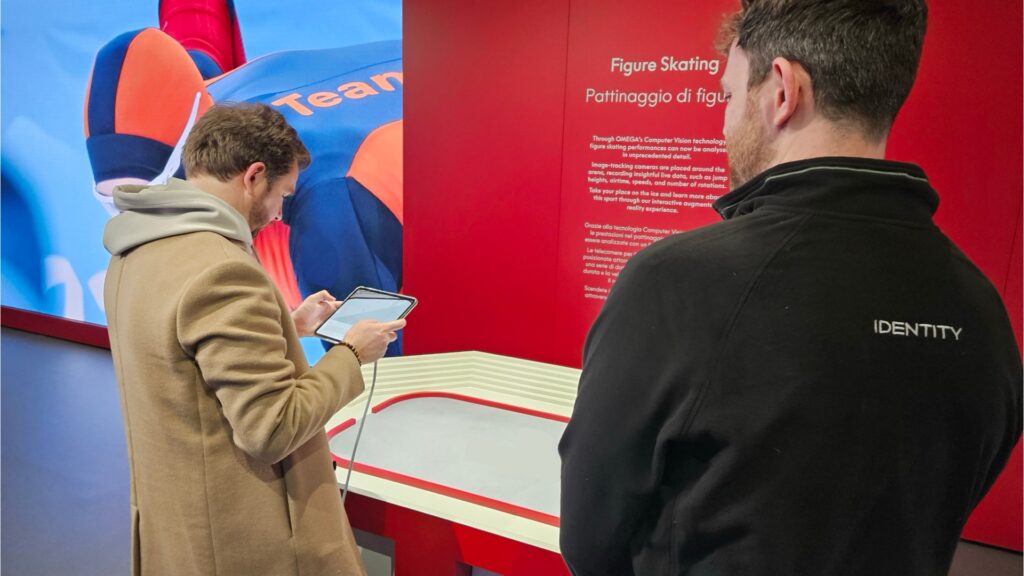
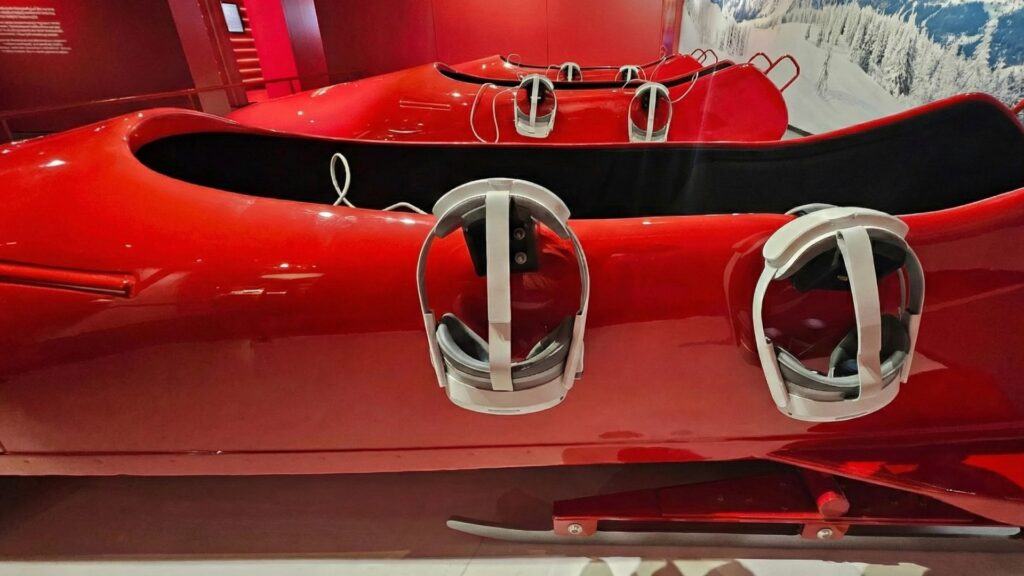
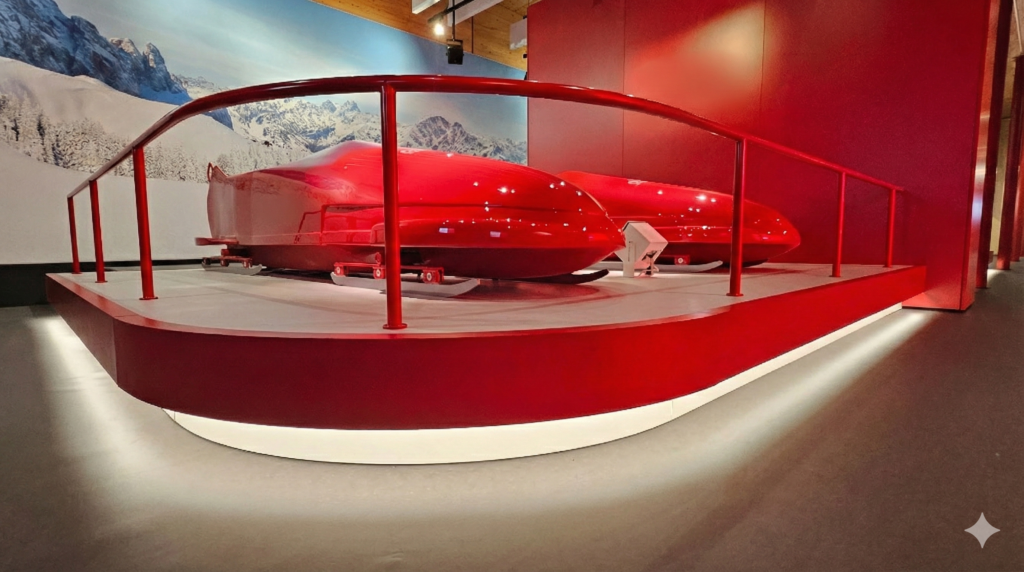
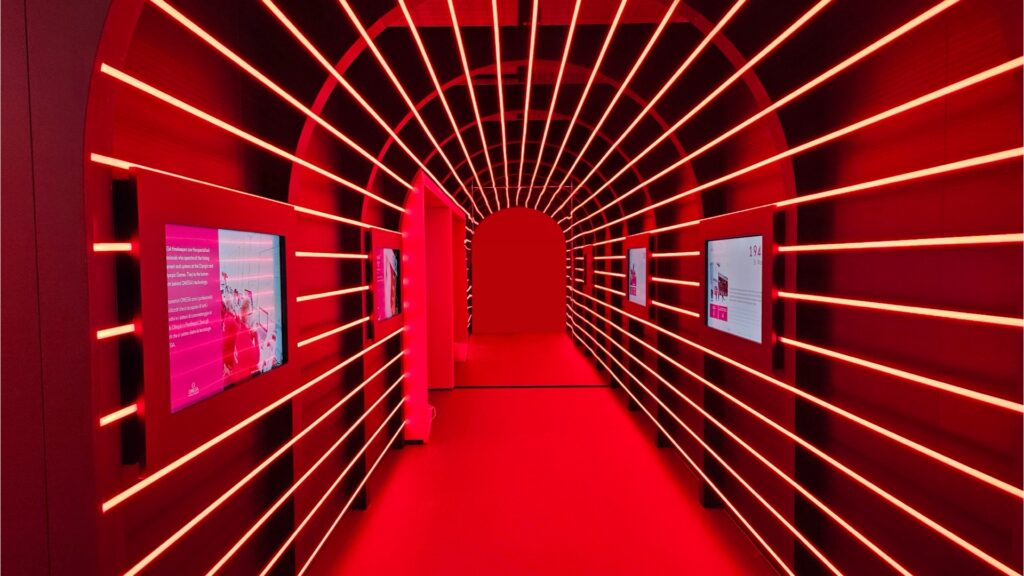
We have spent the past 12 months designing an immersive activation in the city (pictured above), and we took a different starting point. Not what technology can do, but how to place visitors inside the story. The audience would span children to grandparents, sport obsessives to casual tourists. The one thing that connected every group was immersive experience. We looked at the most immersive winter sports, the moments of highest drama, and asked: how do we put people there?
Where friction made the work
It started before the first activation. Most people see the Winter Olympics and Paralympics as the athletes and the podium. But the pressure on the timekeepers is immense, and the logistical challenge behind each event is a story almost nobody sees. We built an entrance as a liminal threshold to take visitors out of their everyday and into that world. Digitally mapped threads of red light ran the length of the space, representing slices of time. A binaural soundscape, with heartbeat, played the timekeepers voices in the seconds before a race starts: the calls, the countdowns, the pressure of precision, placing visitors in the timekeepers’ shoes. By the time they reached the first activation, they were already emotionally present. That perception was not created by technology alone. It was created by storytelling, brought to life through it.
The client wanted the visitors to live and breathe the story. We looked across the Olympic and Paralympic sports. Bobsleigh was the one, placing visitors inside the most physically involving winter sport. We explored 5D cinema chairs, but they failed our share test, nobody films themselves in a cinema seat. We proposed full bobsleighs, but the client’s own four-person sleds created problems. Four strangers pressed together, narrow cockpits with trip hazards, groups of two in a ride built for four. We LIDAR-scanned a real bobsleigh, rebuilt it in 3D CAD, widened it for accessibility and built five custom two-seaters fitted with haptic feedback. Wind, spatial 4D sound and VR headsets completed the immersion, not for the sake of the technology, but to make the storytelling physical. We also built a sixth: a wheelchair-accessible bobsleigh with space for a companion and volume controls for neurodivergent visitors. Accessibility was a design principle from day one, not an afterthought.
The original plan was to film the VR content by drone on a real run. We killed that when no course was available in time. Instead, we built the entire bobsleigh course, soundscape and haptic crescendos from the ground up in Unreal Engine. More friction, but total creative control and the ability to weave the timekeeping narrative directly into the experience.
Our AI-powered freestyle ski activation started as a physical photo opportunity. It failed the share test because visitors in everyday clothes do not sell the illusion of mid-flight above a half-pipe. We pivoted to AI to fuse the visitor in the scene, training the model on six carefully chosen photographs, and refined the output over weeks until every image was photorealistic. People share what feels real, not what looks like a filter. AI earned its place not because it was available, but because it was the answer to a problem we had wrestled with first.
The activation is on track for over 55,000 visitors. The IOC President praised it for ‘bringing timekeeping to life in a really engaging way.’ Press coverage has called it ‘a turning point in luxury media experiences.’ Across social and earned media, we project upwards of 30 million impressions. Not because we chased reach, but because we designed every moment to be worth sharing.
The provocation
In an industry racing to remove friction, the most resonant work we have produced came from leaning into it. Every pivot, constraint and rejected idea made the final experience sharper. AI was part of the toolkit, but it was never the starting point.
Live experiential has never mattered more. In a world saturated with frictionless content, consumers are craving something physical, liminal, emotional: experiences that combine storytelling, craft and technology in ways a screen cannot replicate. But it only works when you bring the rigour and the struggle that AI is quietly removing from everywhere else.
The future of brand experience is not frictionless. It is friction by design.